
Plantar Fasciitis Stretches: 6 Moves for Heel Pain
A practical stretching routine for plantar fasciitis, including plantar-fascia-specific stretching, calf stretches, arch rolling and a gradual strengthening progression.
Why stretching can help plantar fasciitis
The plantar fascia is a strong band of connective tissue along the bottom of the foot. It helps support the arch and absorbs load during standing and walking. Plantar fasciitis typically causes pain near the heel attachment, often with the first steps after waking or after sitting for a while.
Current clinical practice guidance supports both plantar-fascia-specific stretching and gastrocnemius/soleus stretching for people with plantar heel pain. The goal is not to force the tissue aggressively. It is to improve flexibility and reduce painful tension while you gradually restore normal loading.
Start with this 3-minute morning routine
First-step pain is a classic plantar fasciitis pattern, so the morning is a useful time to perform gentle mobility before loading the foot.
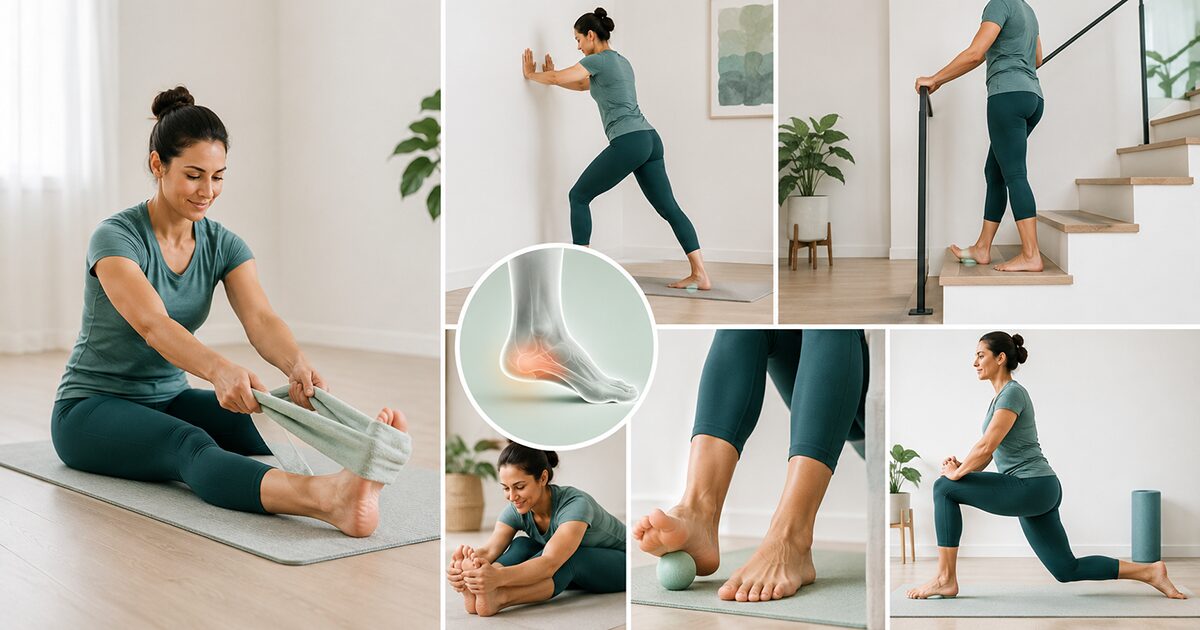
The 6 plantar fasciitis stretches and mobility moves
Plantar fascia–specific stretch
This directly tensions the plantar fascia rather than relying only on calf flexibility.
- Sit in a chair or on the edge of the bed.
- Cross the sore foot over the opposite knee.
- Grasp the base of the toes and gently pull them back toward the shin.
- With the other hand, feel along the arch. The fascia should become firm under the skin.
- Hold without bouncing, then release.
Towel stretch
A good option when reaching your toes is uncomfortable or awkward.
- Sit with the affected leg straight.
- Loop a towel, belt or stretching strap around the ball of the foot.
- Keep the knee straight and gently pull the foot toward you.
- Stop when you feel a comfortable stretch through the calf and heel.
Wall calf stretch with knee straight
This emphasizes the gastrocnemius, the larger calf muscle that crosses the knee.
- Face a wall with both hands supported against it.
- Step the affected leg behind you.
- Keep the back knee straight and the heel on the floor.
- Move your hips forward until you feel a stretch in the upper calf.
Wall calf stretch with knee bent
Bending the back knee shifts more of the stretch toward the soleus, lower in the calf.
- Start in the same position as the straight-knee wall stretch.
- Keep the back heel flat.
- Bend the back knee slightly while keeping your foot pointed forward.
- Sink gently until you feel the stretch lower in the calf.
Arch roll
This is soft-tissue work rather than a true stretch, but it is commonly used as part of foot-and-ankle conditioning.
- Sit in a stable chair.
- Place a tennis ball, massage ball or frozen water bottle under the arch.
- Roll slowly from the heel toward the ball of the foot.
- Use moderate pressure. Do not grind into sharp pain.
Step-edge calf stretch
This can create a stronger calf stretch than the wall versions, so it is better treated as an optional progression rather than a starting exercise.
- Stand on a step while holding a rail or wall.
- Keep the balls of the feet supported on the step.
- Slowly let the heels lower until you feel a comfortable calf stretch.
- Return to level. Do not bounce at the bottom.
Add strengthening as pain allows
Stretching is only one part of rehabilitation. As symptoms settle, progressive strengthening can help the foot and calf tolerate load again. A 2014 randomized trial found that a high-load strength program improved outcomes more quickly than stretching alone in the early phase of treatment, although both groups improved over time.
A simple place to begin is a controlled calf raise while holding a wall or chair. Start with both feet if necessary. Progress only when the exercise does not cause a meaningful increase in pain during the session or the following morning.
A practical weekly routine
| When | What to do | Approx. time |
|---|---|---|
| Before first steps | Move 1 + Move 2 | 3–5 min |
| Midday | Moves 3 and 4 | 3–5 min |
| After a long period on your feet | Move 5 | 1–2 min |
| Evening | Repeat the stretches that feel helpful | 5–8 min |
| Several days per week, as pain allows | Progressive calf/foot strengthening | 5–10 min |
What not to do
- Do not bounce. Use controlled, static stretches.
- Do not push through sharp pain. More force is not automatically better.
- Do not progress several exercises at once. If symptoms flare, you need to know what changed.
- Do not ignore footwear and activity load. Stretching cannot fully offset a major increase in standing, running or other aggravating activity.
- Do not assume every case of heel pain is plantar fasciitis. Persistent or atypical symptoms deserve evaluation.
How long do plantar fasciitis stretches take to work?
Plantar fasciitis usually improves gradually rather than overnight. Many people notice a trend toward less first-step pain over several weeks, while full recovery can take months. Improvement is better judged by function and trends—fewer painful first steps, better walking tolerance and fewer post-activity flares—than by a single good or bad day.
If you are doing a consistent routine and symptoms are not improving, or the diagnosis is uncertain, get evaluated rather than simply stretching harder.
When to see a doctor
- Severe pain after a fall, impact, sudden pop or other injury
- Inability to bear weight normally
- Marked swelling, redness, warmth or fever
- Numbness, tingling, burning, weakness or loss of sensation
- Pain that is prominent at rest or repeatedly wakes you at night
- An open wound or skin breakdown
- New foot pain when you have diabetes, neuropathy or significant circulation problems
- Persistent symptoms that are not improving with a reasonable period of conservative care
Gear that can make the routine easier
See stretching straps
See massage balls
See night splints
See arch-support insoles
Affiliate disclosure: We may earn a commission from qualifying purchases made through links on this page, at no extra cost to you.
Related FeetHealth guides
Frequently asked questions
Which stretch is best for plantar fasciitis?
Current clinical guidance supports both plantar-fascia-specific stretching and calf stretching. Plantar-fascia-specific stretching directly tensions the painful tissue and is particularly useful before the first steps after rest.
Should I stretch plantar fasciitis if it hurts?
A firm, tolerable pulling sensation can be normal. Sharp, stabbing, burning or radiating pain is a reason to reduce the stretch or stop. If your symptoms are consistently worse after stretching, get individualized advice.
How often should I stretch?
There is no single dosage that is right for everyone. Clinical programs commonly use multiple short sessions per day. Consistency and tolerance matter more than forcing a specific number of minutes.
Should I stretch before getting out of bed?
That can be useful when your worst symptom is first-step morning pain. A gentle plantar-fascia stretch before weight-bearing is a practical way to prepare the tissue before standing.
Can stretching make plantar fasciitis worse?
Yes, if it is too aggressive or if the diagnosis is wrong. Avoid bouncing and sharp pain. If stretching repeatedly causes a next-day flare, reduce the intensity or seek evaluation.
Do I need strengthening too?
Often, yes. Stretching may improve flexibility and symptoms, while progressive strengthening helps rebuild the foot and calf’s capacity to tolerate load. Strength work should be introduced gradually.
Medical sources
- Journal of Orthopaedic & Sports Physical Therapy — Heel Pain–Plantar Fasciitis: Revision 2023 Clinical Practice Guideline
- American Academy of Orthopaedic Surgeons — Plantar Fasciitis and Bone Spurs
- American Academy of Orthopaedic Surgeons — Foot and Ankle Conditioning Program
- Mayo Clinic — Plantar Fasciitis: Diagnosis and Treatment
- DiGiovanni et al. — Tissue-specific plantar fascia stretching randomized study
- DiGiovanni et al. — Plantar fascia-specific stretching, two-year follow-up
- Rathleff et al. — High-load strength training in plantar fasciitis
Keep the routine simple enough to repeat
Plantar fasciitis usually responds to a combination of appropriate loading, stretching, support and time. Start with the plantar-fascia stretch and calf stretches, add strengthening gradually, and use your symptoms to guide progression.